
Product Photography Backgrounds for Ecommerce
A product photography background is the surface behind or beneath the product; for ecommerce, choose it by matching material, colour and contrast, usable coverage, and surface condition to the product and intended camera frame. No single colour or material is universally best: the background should separate the product clearly, fill every visible part of the frame, and avoid unwanted texture, marks, joins or reflections.

Choose a product photography background by setup need
Start with the physical job the backdrop must perform, then verify contrast, camera-frame coverage and surface behaviour against the actual product.
Start with seamless paper. It rolls from the vertical background onto the shooting surface and marked sections can be trimmed.
Check: protect it from marks, moisture and physical damage.Consider vinyl. It suits repeated shoots when cleanability matters, but the finish determines how reflective it appears.
Check: make sure reflections remain controlled in the actual setup.Consider fabric such as muslin or canvas. It is portable and can be draped, while its texture may remain visible.
Check: smooth wrinkles and folds when a clean background is required.Consider rigid board or a panel. It stays flat and can work well beneath or behind smaller products.
Check: it must be large enough for the intended frame and cannot form a rollable sweep.Before shooting, verify all four conditions:
- Separation: product and background tones keep important edges distinct.
- Coverage: the backdrop fills the complete intended frame and crop margin, including visible space behind and beneath the product.
- Surface interaction: texture, marks, joins and reflections do not compete with the product.
- Camera-position check: final suitability is judged from the intended camera angle, not from the backdrop in isolation.
Material affects handling and visible texture; colour controls tonal separation; usable dimensions control coverage; and surface condition can introduce marks, creases, joins or reflections.
These background choices define the photographed setting rather than the wider camera, lighting or editing workflow.
Table of Contents
Product Photography Background Types and Material Characteristics
Product photography background types are most usefully distinguished by their physical background material rather than by decorative style alone.
Common classes include seamless paper, vinyl, fabric such as muslin or canvas, and rigid board or similar panels.
Each class has a different combination of surface texture, flexibility, cleanability and handling characteristics, so its suitability depends on how those properties affect the photographed background.
Flexible or rollable backgrounds can extend from a vertical plane into a sweep, while fabric backgrounds can be folded or draped but may show wrinkles or texture if the surface is not kept smooth.
Rigid surfaces remain flat rather than draping, which can make them practical beneath or behind smaller products.
Reflectivity, crease resistance and suitability for repeated use are not fixed by the material name alone because finish, construction, handling and surface condition can change how a particular backdrop behaves.
The physical forms of these material classes are easier to recognise when viewed together: paper is commonly supplied as a roll or sheet, vinyl as a flexible surface, fabric as a foldable or hanging backdrop, and rigid board as a self-supporting panel.

The comparison organises each background material by the surface and handling properties that affect its appearance and use during a product shoot.
The useful context follows from those properties rather than from treating any material as a universal choice.
| Material Type | Surface / Handling Characteristics | Useful Context | Main Limitation |
|---|---|---|---|
| Seamless paper | Rollable paper can form a continuous sweep from the vertical background onto the shooting surface. Used sections can be trimmed when they become marked or damaged. | Clean catalogue-style images where a smooth, visually continuous background is wanted. | Paper is vulnerable to marks, moisture and physical damage, so repeated use depends on keeping the exposed surface in suitable condition. |
| Vinyl | A flexible background surface that can be stored rolled and, depending on its finish, can be wiped clean. Reflectivity varies with the vinyl surface rather than being uniformly matte. | Repeated shoots where cleanability and a flexible backdrop are useful. | Surface finish can produce visible reflections, and rolling or handling requirements depend on the particular construction. |
| Fabric, including muslin or canvas | Flexible and foldable, with surface texture that can remain visible in the image. Muslin and other fabrics can develop wrinkles, while canvas construction and texture vary. | Images where a fabric surface or visible texture is acceptable or intentional. | Wrinkles, folds or texture may remain visible when a smooth background appearance is required. |
| Rigid board or panel | A flat, rigid background surface that does not drape or form a rollable sweep. Cleanability, surface texture and reflectivity depend on the board material and finish. | Tabletop and smaller-product setups where a stable flat background surface is useful. | Rigidity limits folding and sweeping, while larger panels require enough physical space for handling and storage. |
The main criteria split is therefore between flexible or rollable backgrounds, fabric backgrounds and rigid surfaces.
A smooth, non-reflective surface can keep a clean catalogue image visually restrained, whereas a textured fabric or rigid surface can make the background itself more visible; the suitable choice is the material whose physical behaviour supports the intended product image without introducing unwanted texture, reflections or handling problems.
Background Colour, Contrast and Product Separation
Background colour should be evaluated in relation to the product colour and intended presentation, because contrast is created between the subject and its surroundings rather than by the background tone alone.
Greater tonal distinction can increase product separation and make edges easier to distinguish in the described setup, while similar tones can reduce edge definition.
A light background, dark background or neutral background can therefore be suitable when its relationship with the product preserves the visible detail the image needs to show.
A light product against a similarly light background may have less distinct edges where neighbouring tones are close, whereas placing that product against a sufficiently different darker tone can make its outline more apparent.
The reverse relationship can apply to a dark product on a dark background, where limited tonal distinction may make some edges harder to distinguish.
A neutral background can provide separation for products whose tones differ clearly from it without making the background itself visually dominant.
Reflective or translucent products can appear differently against the same background because their visible tone and edges are also affected by reflections, transmitted light and the surrounding shooting conditions.
These three conditions illustrate how relative tonal contrast changes edge visibility; they describe visibility relationships rather than a ranking of background colours.
- Light-on-light: when the product colour and light background are close in tone, contrast can decrease and some edges may become less distinct.
- Light-on-dark: when a light product is placed against a distinctly darker background, greater tonal contrast can make its outline and separation more apparent.
- Neutral-on-coloured: when a neutral-coloured product and coloured background remain sufficiently distinct in tone, the product can retain visible edge separation without requiring either an extremely light or dark background.
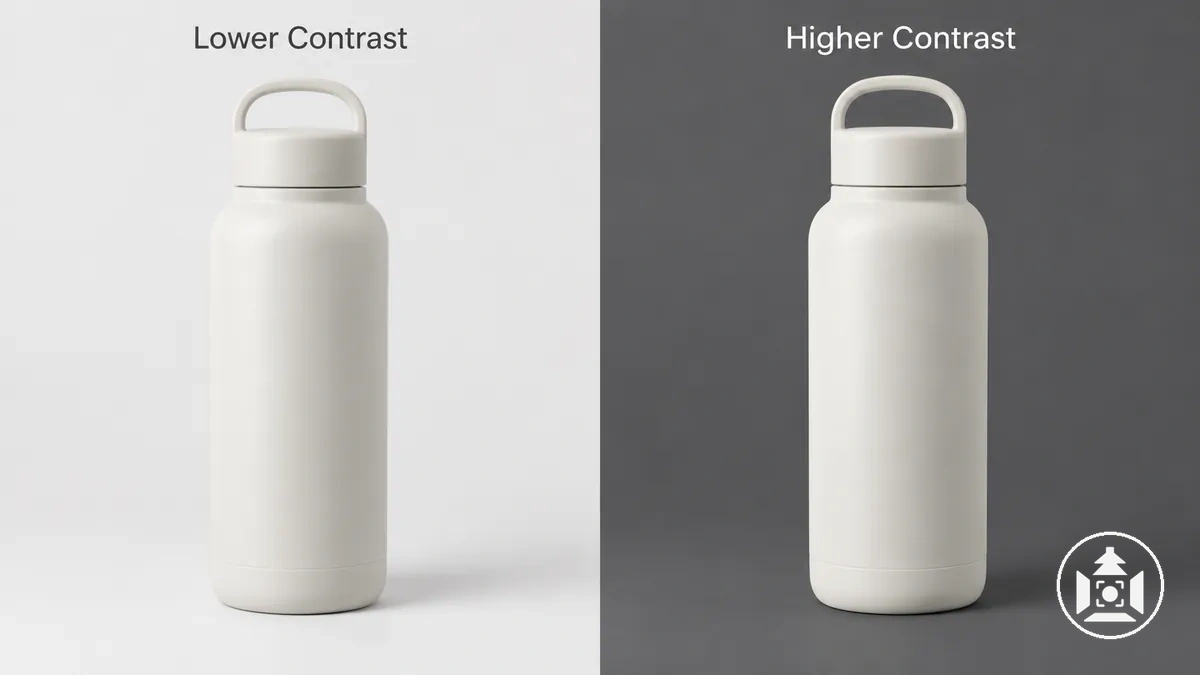
A pale product that loses edge definition against a similarly pale background may become easier to distinguish against a more distinct background tone, provided reflections or transparency do not change the visible relationship.
Across a product set, consistency also depends on keeping the intended background colour reasonably stable between repeated shoots; a visible colour shift can change the apparent contrast and product separation from one ecommerce product image to another.
The practical check is the actual product against the actual background tone, with its edges and relevant detail visible under the shooting conditions being used.
Background Size and Coverage Around the Product
Background size should be determined by the product dimensions, intended framing and the area the camera must see, rather than by one universal backdrop measurement.
The required backdrop width and backdrop length are the dimensions that provide enough coverage to keep background edges, supports and surrounding room outside the intended camera frame.
There is no useful universal backdrop minimum independent of the setup: required background area increases when product size, framing or shooting angle exposes more space around, behind or beneath the product.
Start with the product footprint and product height, then evaluate how the intended framing extends around and beyond those dimensions.
Backdrop width must provide enough side coverage for the camera frame and crop margin, while vertical coverage must extend behind the product wherever the chosen shooting angle can expose the rear background.
When the composition shows the surface beneath or in front of the product, backdrop length must also continue far enough forward to fill that visible area.
Subject-to-background spacing can increase the rear area visible from some shooting angles, so the required coverage must be checked from the intended camera position rather than from product dimensions alone.
The three coverage directions separate the areas that the camera can expose around the product and show which backdrop dimension needs to change with the framing.
- Width and side coverage: a wider product footprint, wider framing or greater side margin requires more usable background area to the left and right of the product.
- Vertical and rear coverage: greater product height or framing that includes more space above and behind the subject requires the backdrop to extend farther vertically or rearward.
- Forward and beneath-product coverage: a shooting angle that exposes more of the supporting surface requires additional backdrop length beneath and in front of the product.
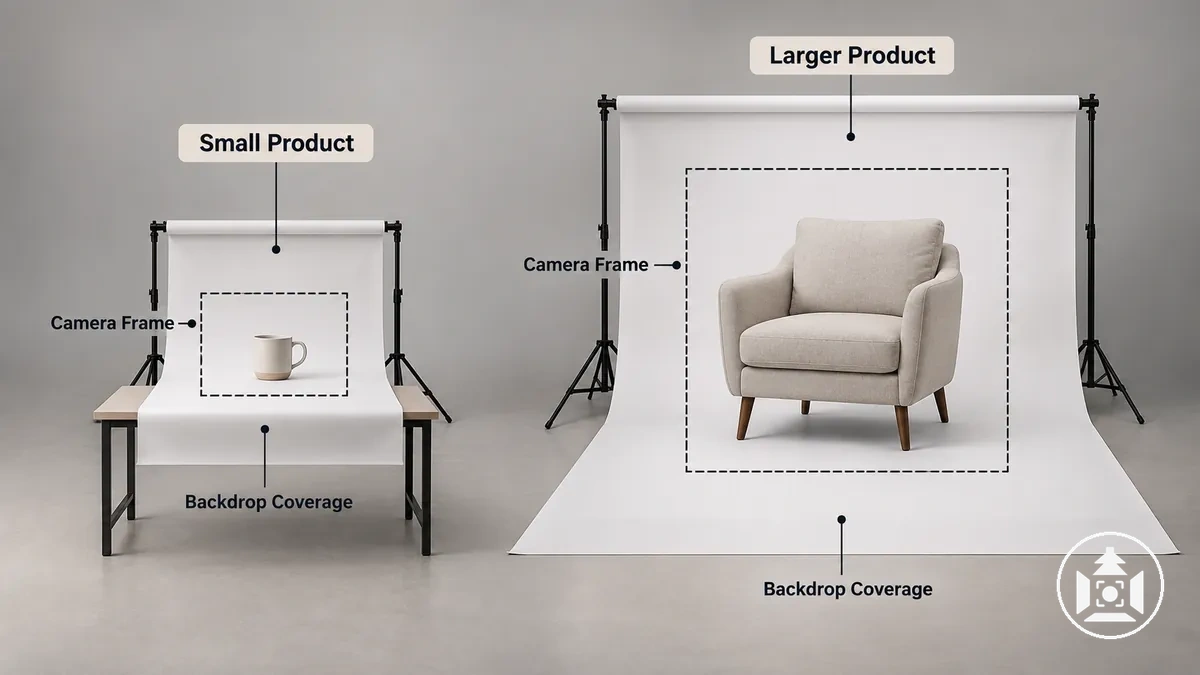
A small tabletop product can fit within a relatively compact usable background area when the framing stays close, while a taller or wider product requires greater side, rear or vertical coverage when more surrounding space enters the shot.
Planned angles and composition for product images can increase or reduce the required coverage because changing the shooting angle and framing changes which parts of the backdrop can appear.
Before shooting, check the intended camera frame and crop margin to confirm that the backdrop fills every visible area around and beneath the product without exposing its edges, supports or the surrounding room.
Matching Background Characteristics to the Product
Background suitability depends on the product characteristics and intended ecommerce presentation rather than on one background property in isolation.
Evaluate the product colour, surface reflectivity, product size, product shape and desired visual character against what the background needs to do in the image.
The same background can be suitable when those characteristics support clear presentation, yet become distracting or difficult when its colour, surface or physical form conflicts with the product.
The criteria below prioritise product-dependent conditions from visual separation and surface interaction through to physical fit and practical repeatability.
Each criterion connects a product condition with the background characteristic that needs to accommodate it.
- Visual separation: evaluate product colour against background colour and contrast; when the tones are too similar for the intended image, reduced edge separation can make the product outline less distinct.
- Surface interaction: evaluate surface reflectivity against what the background may contribute to visible reflections; a highly reflective surface can show more of the surrounding environment, making visually controllable background surfaces and surroundings more important.
- Physical fit: match product size and product shape to sufficient coverage and sweep behaviour; taller, wider or irregular products require a background form that remains continuous throughout the intended framing.
- Intended background character: use a neutral background when the presentation calls for a visually restrained setting, while visible texture is suitable only when that texture supports rather than competes with the intended product presentation.
- Practical repeatability: evaluate cleanability and repeatability against the shooting workflow; when the same background must be used across repeated images, its surface condition needs to remain sufficiently consistent for the required presentation.
A reflective product illustrates why these criteria must be combined rather than applied independently.
Even when product colour and background colour provide clear edge separation, surface reflectivity may make the backdrop or surrounding environment visible in the product, so background choices for reflective products require attention to which backdrop characteristics remain visually controllable in the specific setup.
The image below demonstrates this condition-dependent matching by showing different product surface and shape conditions against background properties such as contrast, reflectivity and texture.
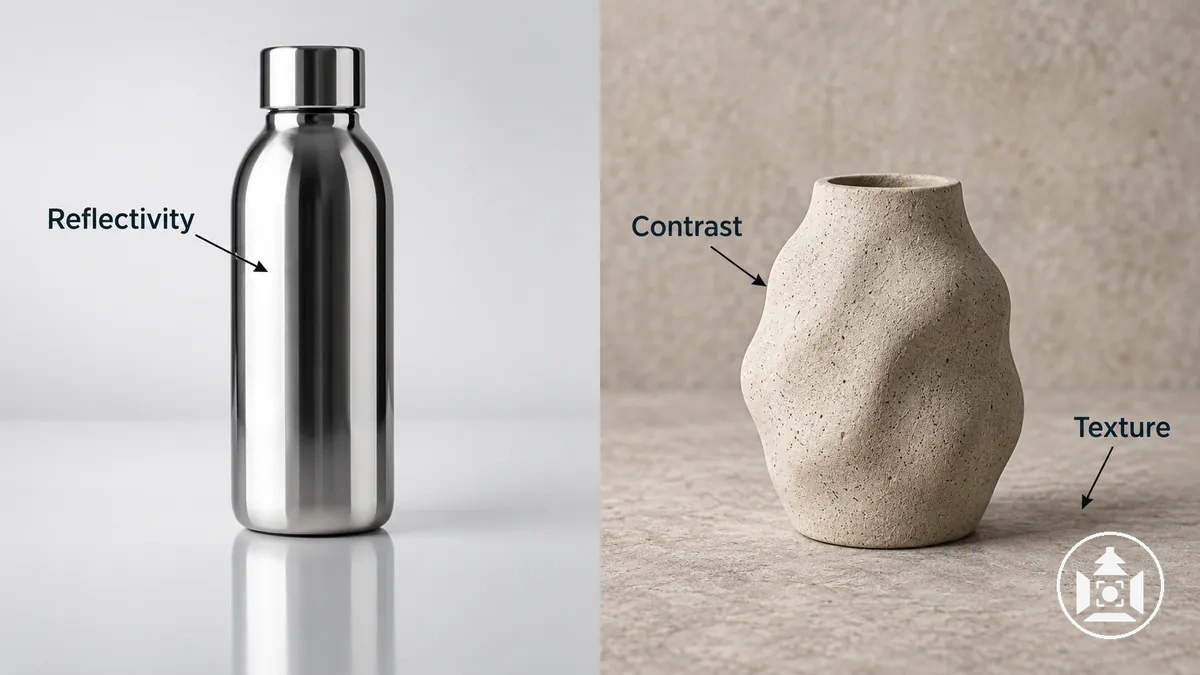
Background-property selection should remain separate from the broader decision about whether the product is presented in isolation or within a contextual scene.
The choice between white background versus lifestyle photos concerns the overall image style, while these suitability criteria determine whether the selected background characteristics fit the product within that presentation.
Background suitability is therefore established by matching the product's visual and physical conditions to the required separation, surface behaviour, fit, background character and practical consistency.
Setting Up a Clean, Seamless Product Background
A clean product background setup depends on stable support, adequate background coverage and verification through the camera frame.
Secure backdrop material so it stays in the intended position, then provide enough vertical coverage and horizontal coverage to keep the camera-visible field within the usable area; the amount required varies with product size, backdrop material and framing.
The sequence establishes a usable background before fine surface corrections such as detailed sweep shaping or flattening.
Each step pairs one setup action with an immediate check of the background visible to the camera.
- Secure the background: secure backdrop material to stable support so it remains in the intended position behind and, where required, beneath the product. Verify that the support and backdrop boundary remain outside the intended camera frame.
- Confirm coverage: confirm that vertical coverage extends beyond the visible area behind the product and horizontal coverage extends beyond both sides of the intended framing. If the backdrop also forms the shooting surface, confirm that it covers the area visible beneath and in front of the product.
- Position the product: position the product within the usable area so the required background remains visible around it from the intended camera position. Verify that the placement does not bring a visible edge or support into the planned crop.
- Inspect the camera frame: inspect the frame perimeter and visible shooting surface for a visible edge, support or unintended line. Adjust background coverage or product placement if any of these elements enter the intended frame.
The setup can also be checked visually by following the secured backdrop through its covered area to the product and the final camera framing.
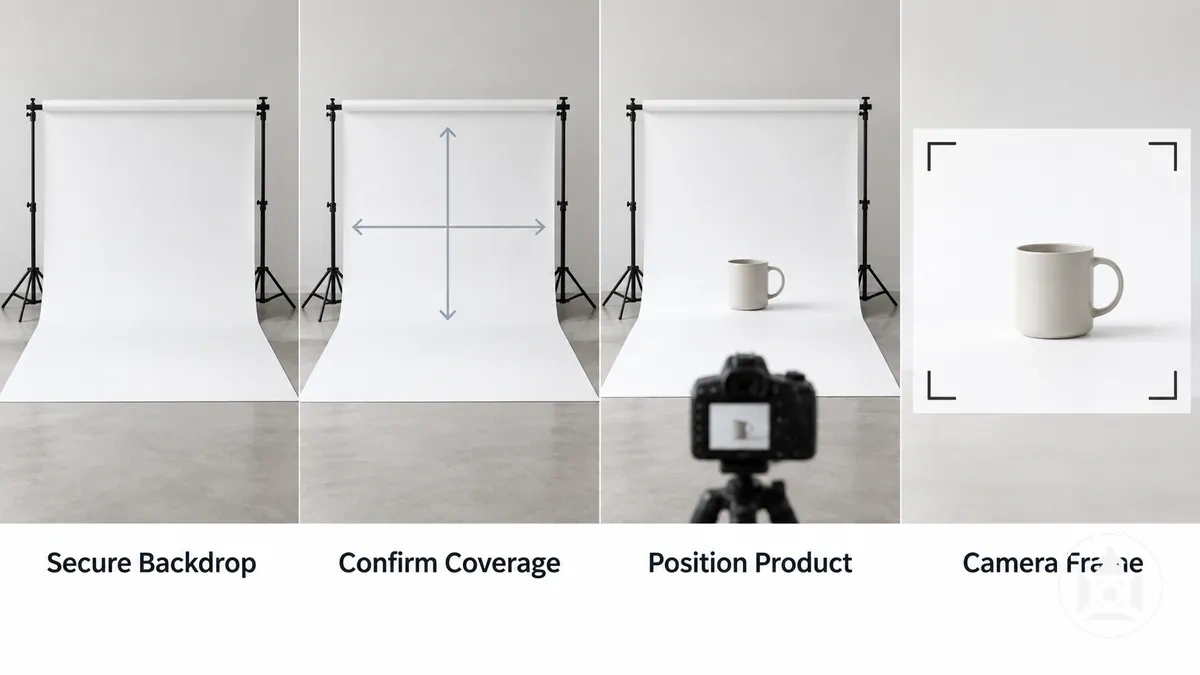
Make final verification from the camera position because the camera frame determines which backdrop edges, supports and surface lines are included in the image.
When a seamless transition is required, the sweep should form a continuous visible transition behind and beneath the product without an unintended line, while obvious surface irregularities should be flattened only as far as the backdrop material permits.
Keep detailed sweep shaping and surface flattening for their dedicated steps, then verify the camera frame again after those adjustments.
Background preparation ends when the backdrop is secure, the required area is covered and unwanted edges or supports remain outside the intended frame.
Camera settings, lighting and the wider ecommerce photography setup continue beyond background preparation.
Creating a Smooth Sweep Between Surface and Backdrop
A seamless sweep is a gradual curve between the horizontal surface and vertical backdrop that avoids forming a hard corner behind the product.
A sharp fold creates a defined change in background geometry that can appear as a horizon line, while a gradual curve creates a continuous transition that can make that line less apparent when the backdrop material and camera framing allow it.
The sequence controls the transition geometry from the supported vertical backdrop to the horizontal surface.
Form the sweep without forcing a sharp crease, then verify the resulting transition from the camera position.
- Leave material for the curve: allow enough backdrop material between the vertical and horizontal sections to form a gradual bend rather than pulling it into a hard corner.
- Support the vertical backdrop: keep the upper portion supported so the backdrop can descend toward the horizontal surface without collapsing into an unintended fold.
- Form the seamless sweep: curve the backdrop gradually through the transition and avoid creating a sharp crease where its direction changes.
- Verify from the camera position: inspect the transition behind the product and adjust the curve if a hard corner, crease or horizon line is visible within the intended frame.
Keeping the Background Surface Clean, Flat and Crease-Free
Background surface condition should be judged from the camera frame immediately before shooting because framing and product scale affect which defects are visible and how prominent they appear.
A clean surface, flat surface and crease-free background should therefore be evaluated by what is actually visible around the product in the intended frame.
The checklist identifies physical surface defects that can enter the camera frame and affect the photographed background.
Check cleanliness first, then shape and stability, while judging unwanted texture or reflection under the actual framing being used.
- Dust and marks: check the visible backdrop surface for dust or marks that can appear as spots or unwanted visible detail around the product.
- Wrinkles and creases: check for wrinkles or a crease that creates a visible line, shadow or unintended texture within the camera frame.
- Sagging: check whether loose or unsupported areas are sagging enough to create a visible change in background shape or surface texture.
- Curling edge: check whether a curling edge enters the frame or changes the visible shape of the background near the product.
- Visible join: check any join between background sections and correct it when the join appears as an unintended line or change in surface appearance.
- Support stability: check that each support holds the backdrop in its intended position and does not allow movement or a support element to become visible within the frame.
- Unwanted texture or reflection: check whether surface texture or a reflection is visible enough to interfere with the intended background appearance under the current framing and shooting conditions.
Correct visible physical defects at the backdrop before relying on image editing as the primary cleanup method.
Recheck the camera frame after correction to verify that the relevant defect is no longer visibly distracting in the intended image.
Background Mistakes That Distract From the Product
A background mistake is a background condition that competes with, obscures or introduces visible defects around the product in the final camera frame.
The main background-specific failure pattern occurs when a distracting background competes with the subject or when defects such as insufficient contrast, a wrinkle, hard transition line, inadequate coverage, visible dirt or a visible join interfere with product separation.
A reflective surface can also become a backdrop problem when uncontrolled reflections introduce visible detail that competes with the product.
The table separates each background mistake into its visible consequence, recognition cue and corrective direction.
Diagnose how the problem appears in the final frame first, then apply the background-specific correction without treating unrelated lighting, focus, colour-management or composition problems as backdrop errors.
| Background Mistake | Visible Consequence | Recognition Cue | Corrective Direction |
|---|---|---|---|
| Busy or competing background | Background patterns, objects or strong visual detail can distract from product prominence. | Background elements attract attention before or alongside the product instead of remaining visually subordinate. | Simplify the visible background and retain only background detail that supports the intended presentation. |
| Insufficient contrast | Similar product and background tones may reduce edge definition and product separation. | Parts of the product outline become difficult to distinguish where its visible tone approaches the background tone. | Change the background tone or another controllable background characteristic to create sufficient visible separation for the product. |
| Wrinkle or hard transition line | A visible wrinkle, crease or abrupt backdrop bend creates an unintended line or texture behind the product. | A line, fold or horizon-like transition remains visible within the intended camera frame. | Flatten the affected surface or reshape the backdrop transition into a gradual sweep where the setup requires one. |
| Inadequate coverage | Backdrop edges, supports or surrounding room can enter the image. | The camera frame extends beyond the usable background area at the sides, above, behind or beneath the product. | Increase or reposition the available background coverage so the backdrop fills every required part of the intended frame. |
| Visible dirt or visible join | Dust, marks, spots or a join can introduce unintended visible detail around the product. | A mark, spot or boundary between background sections remains visible in the photographed area. | Correct the physical surface condition or reposition the usable background area so the unwanted detail is outside the intended frame. |
| Uncontrolled reflective or glossy surface | A reflective surface may show highlights or surrounding detail that competes with the intended background appearance. | Reflections or reflected surroundings become conspicuous within the background area or near the product. | Use a background surface or orientation whose reflections remain visually controlled under the specific shooting conditions. |
The highest-value recognition cues are those that can be traced directly to the background: weak edge separation points to the product-background relationship, while a visible wrinkle, hard line, dirt, join or backdrop edge identifies a physical background condition in the frame.
Reflections can involve both the surface and surrounding lighting conditions, so their presence alone does not establish the background as the only cause.
Blur, inaccurate colour, exposure problems and poor composition belong to other photography contexts rather than being diagnosed as background mistakes.
Choose the corrective direction by inspecting what actually distracts from or obscures the product in the final camera frame rather than by treating one background style as universally preferable.