
DIY vs Professional Ecommerce Product Photography
DIY product photography is usually the practical choice when your team can reliably reproduce the required image standard with the skill, time, equipment, shooting control and review capacity already available. Professional product photography becomes more practical when a specific technical, consistency, throughput or time requirement exceeds internal capability; neither approach is universally better or cheaper.
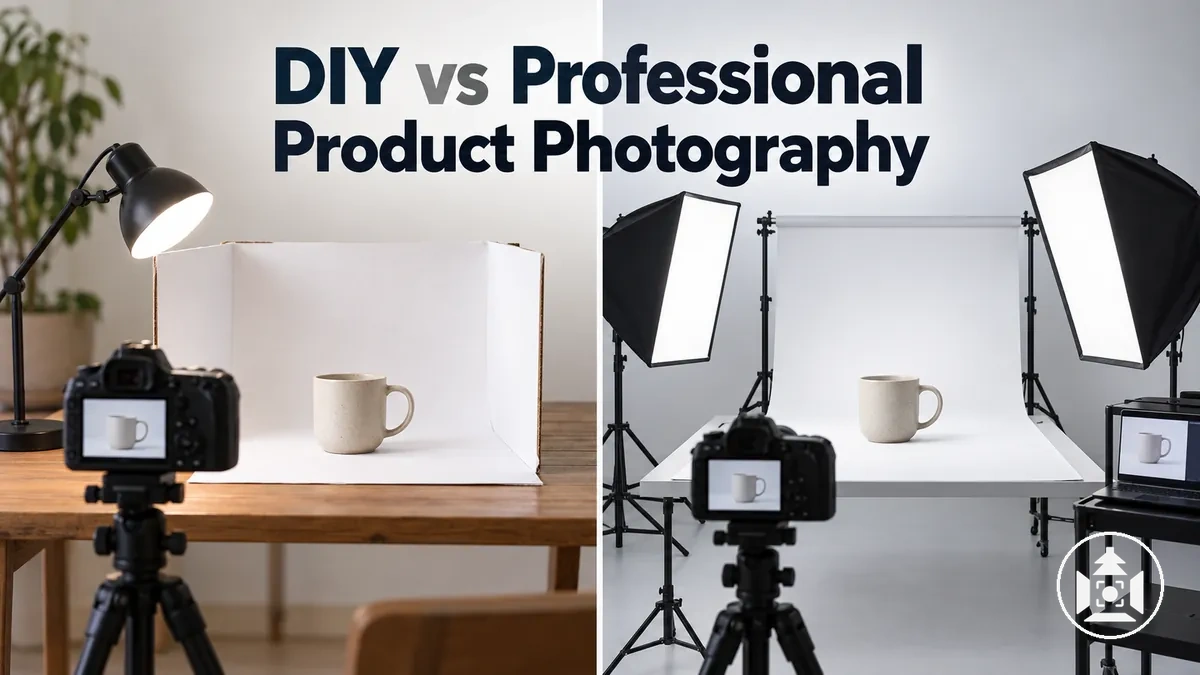
Choose by the constraint that limits production
Start with the image quality and repeatability you need, then compare that requirement with your internal capability. Each row is a decision condition, not a score or fixed threshold.
- Quality and repeatability
- DIY fit The required standard can be reproduced reliably with stable internal lighting, framing, colour handling, editing and quality checks.
- Professional fit Tighter technical control or recurring consistency requirements expose a gap in the current internal process.
- Product difficulty
- DIY fit The product's surfaces, styling, detail and required angles are manageable with the team's existing capture and retouching capability.
- Professional fit Reflective, transparent or otherwise demanding products require control that the current setup cannot reproduce reliably.
- Skill and time
- DIY fit Sufficient skill and hands-on time are available for preparation, capture, editing, review and any necessary reshoots.
- Professional fit Missing specialist skill or insufficient production time creates rework, delay or displacement of higher-priority work.
- Volume and frequency
- DIY fit Product and shot volume fits the business's capture and review capacity, including recurring additions.
- Professional fit Required throughput, production frequency or multi-channel deliverables exceed internal capture or review capacity.
- Total resource commitment
- DIY fit Internal labour, equipment, space, learning and expected rework are acceptable for the required output.
- Professional fit Provider fees plus coordination are less constraining than carrying the required specialist execution and production capacity internally.
Decision rule: keep production DIY while the required output is reproducible within internal capacity; add professional involvement when a specific capability or capacity gap remains.
Suitability changes with the required image quality, repeatability and the resources available to produce that output.
DIY and professional ecommerce product photography distribute production responsibility, time, skill and resource commitment differently.
Image quality and consistency depend on conditions such as product difficulty, shooting environment, process control and quality assurance, while the workload depends on how much preparation, capture, correction and coordination remains internal.
Scale also changes the comparison because recurring or larger product volumes place greater demands on repeatable production and internal capacity.
DIY product photography can reduce external spend and provide greater creative control when sufficient time and skill are available, but it keeps more production responsibility inside the business.
Professional product photography can externalise specialist work and may support greater repeatability when production requirements are more demanding, while still requiring business-side coordination; image quality and repeatability therefore provide a useful first lens for comparing the two approaches.
Table of Contents
Image Quality and Consistency in DIY and Professional Product Photography
Image quality and consistency are related but distinct in DIY and professional product photography: image quality concerns the technical and perceptual result of an individual image, while consistency concerns how reliably that standard is reproduced across products and shoots.
Either approach can meet an ecommerce requirement under suitable conditions, but the effort and repeatability involved change with skill, control and product difficulty.
The comparison is most useful when DIY and professional production are judged against the same criteria rather than against the production label alone.
Lighting control, sharpness and detail, colour accuracy, background control, framing, retouching and repeatability show where differences are most likely to emerge.
| Criterion | DIY product photography | Professional product photography |
|---|---|---|
| Lighting control | Can be controlled effectively when the shooting environment and light placement remain repeatable; changing ambient conditions increase variation between images. | Can provide tighter control when specialist lighting and a controlled environment are used, especially for products with difficult surfaces. |
| Sharpness and detail | Can produce clear detail when focus, stability and capture technique are controlled; inconsistent technique increases the risk of uneven sharpness. | Specialist capture methods and quality checks can make sharpness and detail easier to reproduce across a larger set, although execution still determines the result. |
| Colour accuracy | Can remain accurate when lighting and colour-management conditions stay stable; mixed or changing light and inconsistent correction can alter product appearance. | Controlled capture and post-production can support more repeatable colour rendering when colour accuracy is included in the production brief. |
| Background control and framing | Can remain consistent with fixed backgrounds, camera positions and framing references; manual recreation increases the chance of drift between shoots. | Defined production controls can make background, framing and crop relationships easier to reproduce across products and recurring sessions. |
| Retouching | Quality depends on the operator's editing skill and on whether the same correction process is applied consistently. | Specialist retouching and an established quality-assurance process can provide more consistent finishing when those steps are part of production. |
| Repeatability | Can be high when equipment, environment and process control remain stable, but maintaining those conditions requires internal discipline. | Can be easier to maintain when lighting, capture, retouching and quality checks follow a repeatable production system. |
Product difficulty changes how significant these differences become.
A simple matte product photographed in a controlled environment can reduce the practical gap between capable DIY and professional production, while reflective, transparent or intricately styled products place greater demands on lighting control, capture skill and retouching.
Professional production may therefore reduce the amount of internal technical problem-solving under difficult conditions, while well-controlled DIY production can still deliver suitable image quality and consistency when the required skill, equipment and quality assurance are available.
The visual below shows how control of the shooting environment supports repeatability without duplicating the comparison criteria in the table.

Technical Image Quality Differences
Technical image quality describes the observable characteristics that make a product image accurate, clear and visually controlled.
In this comparison, those characteristics include lighting control, exposure, focus, sharpness, colour accuracy, detail retention, reflections, glare and post-processing finish rather than the equipment category used to create the image.
Each technical attribute has a visible implication, so the useful test is whether the capture conditions and production process control that attribute well enough for the product being photographed.
The core relationships are:
- Lighting control and exposure: controlled illumination and suitable exposure can preserve visible tonal detail, while uneven lighting or unsuitable exposure can obscure highlights, shadows or product features.
- Focus, sharpness and detail retention: accurate focus and stable capture can preserve defined product edges and surface detail; focus errors or movement can reduce visible sharpness where detail is required.
- Colour accuracy: stable lighting and consistent colour handling can keep product appearance more consistent, while changing light conditions or inconsistent correction can introduce visible colour shifts.
- Reflections and glare: reflective or transparent surfaces can show unwanted reflections or glare when lighting control does not suit the surface, reducing the visibility of shape, texture or detail.
- Post-processing finish: consistent correction can refine exposure, colour and visible imperfections, while uneven processing can create distracting differences or an unnatural product appearance.
A simple matte product photographed under stable conditions may place fewer demands on lighting control and reflection management, which can narrow the technical gap between capable DIY and professional production.
Reflective, transparent or intricately styled products can increase the technical burden because reflections, glare, focus, colour and fine detail may require tighter control throughout capture and finishing.
The visual below highlights technical characteristics such as controlled highlights, defined product edges and visible surface detail without treating those characteristics as a complete capture method.

Consistency Across an Ecommerce Product Catalogue
Ecommerce product catalogue consistency is the repeatability of relevant visual attributes across products and separate shoots, rather than the success of one isolated image.
A catalogue remains visually coherent when its intended presentation can be reproduced as new products and images are added.
The supporting visual illustrates this catalogue-level repeatability across separate product image batches.

Catalogue consistency depends on controlling the same visual variables repeatedly, while the acceptable degree of variation depends on the product range and intended presentation.
Lighting and background should remain compatible with the chosen visual standard, while framing, apparent product scale, colour treatment, crop and editing style should align closely enough for images to read as part of the same catalogue.
- Lighting and background: stable treatment reduces unintended changes in brightness, shadow character and backdrop appearance between product images.
- Framing and scale: repeatable positioning and apparent product size help products occupy the image area in a coherent way.
- Colour treatment: consistent colour handling reduces unintended shifts in how related product images appear together.
- Crop and editing style: aligned cropping and finishing choices support a repeatable presentation across separate batches.
Variation in these attributes can weaken catalogue cohesion and may increase quality-control effort or reshoot risk when images fall outside the intended visual standard.
A one-off batch produced under stable conditions can be easier to align, while recurring catalogue additions may require tighter control because the same presentation has to be reproduced across later shoots.
This comparison identifies the attributes that influence repeatability without prescribing a complete standardisation workflow.
A dedicated product photography consistency process can define how those attributes are documented, checked and maintained across ongoing production.
Time, Skill and Workflow Demands of Each Approach
The production workload of DIY and professional product photography differs across hands-on time, learning requirements and workflow responsibility, not just shooting time.
DIY production retains more preparation, shooting, editing and quality checks internally, while professional production can transfer specialist execution but still requires business-side coordination, approvals and feedback.
The supporting visual illustrates how hands-on production responsibility and coordination or review responsibility can sit differently across the two approaches.

Hands-on production work and coordination or review work should therefore be compared separately.
The relevant workload includes preparation, shooting, reshoots, editing and quality checks on the execution side, alongside briefing, coordination, revisions, approvals and delivery management on the business side.
| Workload area | DIY product photography | Professional product photography |
|---|---|---|
| Preparation | The business retains preparation work, including organising products and the shooting environment. | The business may transfer specialist production preparation while retaining product readiness, requirements and briefing responsibilities. |
| Shooting | Hands-on capture remains internal and requires available staff time and sufficient skill for the intended images. | Specialist capture can be transferred to the provider, reducing internal hands-on shooting work. |
| Reshoots | The business performs additional capture when its own quality checks identify images that need another attempt. | The provider may perform additional capture according to the arrangement, while the business can retain review and feedback responsibilities. |
| Editing | Post-production remains an internal task when the business completes its own images. | Post-production can be transferred when editing is included in the provider's scope. |
| Quality checks | The business evaluates its own output and decides whether images meet the required presentation. | Provider-side checks can support production, but the business may still need to review whether delivered images meet its requirements. |
| Coordination | External coordination can be limited, but internal production responsibility remains with the people organising and completing the shoot. | Coordination load can include briefing, product handover, scheduling, feedback and revision communication according to the provider arrangement. |
| Approvals | Production and approval can sit within the same business, although review responsibility still remains. | Final review and approvals can remain business-side responsibilities unless the agreed workflow assigns them differently. |
Skill level, product complexity, shot volume, available staff time and process maturity determine how much work remains internal or can be transferred externally.
An owner photographing a small batch personally may accept the learning and hands-on workload when the required skills and time are available, whereas a larger recurring shoot may make transferring specialist execution more practical when internal capacity is constrained.
Professional production can reduce internal capture and post-production work when those tasks are included in scope, but coordination and review work remain dependent on the provider arrangement, revision cycle and division of responsibilities.
Hands-On Time and Learning Requirements
DIY product photography has no universal hours-per-product requirement because hands-on time and learning requirements change with existing skill, product complexity, shot count, setup repeatability, editing needs and reshoots.
Strong existing competence and repeatable conditions can reduce active production time, while unfamiliar techniques, difficult products and repeated correction cycles can increase the time needed to produce usable images.
The supporting visual contrasts active DIY production and learning with the narrower briefing, review and coordination time that can remain when specialist execution is transferred to professional production.

Existing capability determines how much of the work can be performed immediately, while the learning curve determines how much additional time is needed to understand and practise unfamiliar tasks.
The main criteria show why two businesses photographing the same number of products can face different DIY time requirements.
- Existing skill: prior competence in lighting, composition, styling, capture and post-processing can reduce the amount of new learning required; unfamiliar techniques add learning and practice before they can be applied reliably.
- Product complexity: straightforward products under controlled conditions can require fewer adjustments, while reflective, transparent or intricately styled products may add hands-on work and corrections.
- Shot count: more required product images increase the amount of capture and review work, although repeatable conditions can reduce repeated setup effort between shots.
- Setup repeatability: a setup that can be reproduced reliably reduces repeated preparation and adjustment, while changing conditions can add active production time.
- Editing needs: images requiring more correction or post-processing add hands-on work after capture; simpler finishing requirements retain less of that burden.
- Reshoots: failed or unsuitable captures require another production cycle, so more frequent reshoots increase hands-on time through repeated preparation, shooting and review.
The learning burden is cumulative because lighting, composition, styling, capture and post-processing are separate capabilities that may each require attention when existing skill is limited.
Setup repeatability also affects how often preparation and adjustments must be repeated, so a documented DIY product photography setup can reduce repeated setup work when the same conditions can be reproduced.
Production Responsibility and Workflow Coordination
Production responsibility differs from the way each photography task is executed: DIY production keeps most task ownership within the business, while professional production can delegate selected execution to an external provider.
Planning, briefing, logistics, review and approvals can still remain business responsibilities when capture or other production work is delegated.
Task ownership determines where coordination and handoffs occur, and the exact split varies with the provider, team and agreed scope.
The main responsibility categories show how internal workload can shift without implying that either approach removes quality-control responsibility.
- Planning and shot requirements: DIY production keeps planning and interpretation of shot requirements internal; professional production can delegate execution against those requirements, while the business still communicates the required output.
- Product preparation and styling: the business owns these tasks in DIY production, while professional arrangements may delegate some styling or preparation when included in scope, creating a handoff where products and requirements must be coordinated.
- Capture: DIY production keeps capture internal; professional production typically delegates capture to the photographer or production team, shifting execution without eliminating the need for an agreed brief.
- File handling and post-production: DIY production keeps file organisation and post-production internal, while professional production may delegate either task according to scope and still require clear delivery requirements.
- Quality review and revisions: DIY production combines execution and internal review, while professional production can divide production from business-side feedback, so unclear requirements or handoffs may create additional revisions and rework.
- Approvals and delivery: the business retains responsibility for deciding whether images meet its requirements, while responsibility for preparing and delivering final files depends on the production arrangement.
Quality review, revisions, approvals and delivery remain coordination points even when specialist production is delegated.
Professional production still requires business input when the agreed workflow assigns briefing, logistics, feedback or final approval to the business, with the coordination burden shaped by that division of responsibilities.
Post-production is a neighbouring implementation context because responsibility for image finishing and file preparation may remain internal or pass through a handoff without changing the broader ownership logic described here.
The detailed product photo editing workflow covers how those post-production tasks are carried out rather than who coordinates them.
Cost and Production Scale Trade-Offs
Cost in DIY and professional product photography is best compared as total resource commitment rather than professional fees or direct spend alone.
DIY production can avoid some external fees but still consumes internal labour, equipment, shooting space, learning time and rework capacity, while professional production shifts more of the production burden into external fees and coordination.
No universal price or break-even point applies because rates, labour value, existing resources, product complexity, quality standards and production scope vary.
For a fair comparison, treat DIY resource commitment as equipment, shooting space, software or consumables plus internal labour, learning and expected rework; treat professional resource commitment as provider fees plus logistics, coordination, review and any production work retained by the business.
Across both approaches, direct spend, internal labour, equipment, shooting space, reshoots, coordination and recurring production needs should be considered against production volume and shooting frequency.
| Cost and scale criterion | DIY product photography | Professional product photography |
|---|---|---|
| Direct spend | External production fees can be limited, but the business may still pay for equipment, props, software, consumables or suitable shooting space. | Professional fees create a clearer external cash cost, with the amount depending on scope, product requirements, provider and market. |
| Internal labour | Preparation, capture, editing, review and related production work consume staff or owner time, so internal labour remains part of the resource cost. | Specialist execution can be transferred externally, but briefing, logistics, review, feedback and approvals can still consume internal labour. |
| Equipment and shooting space | Equipment and space may require new investment or continued internal maintenance when suitable resources are not already available. | Professional production can reduce the need for the business to maintain its own specialist equipment or shooting space when those resources are included in the provider's scope. |
| Reshoots and rework | Reshoots consume additional internal time and production capacity when images do not meet requirements. | Rework may be handled externally or shared with the business depending on the brief, revision process and provider arrangement. |
| Coordination | External coordination can be limited, but the business carries the internal burden of organising and completing production. | Coordination becomes an explicit resource requirement through briefing, scheduling, product handoff, feedback and approvals. |
| Recurring production | Repeated shoots can spread the usefulness of existing equipment, shooting space and learned processes, but they continue to consume internal capacity. | Recurring production continues to generate professional fees, while established briefs and handoffs may make repeated coordination more predictable. |
| Production scale | Higher production volume and shooting frequency can increase internal workload when staffing, space or process maturity do not expand with demand. | Higher volume can transfer more execution externally, but the resulting resource burden still depends on professional fees, coordination demands and the agreed production scope. |
Production volume changes the significance of both fixed and recurring resource burdens.
A small launch batch may make existing equipment, available staff time and a simple product range sufficient for DIY production, while recurring multi-SKU work can make internal labour, reshoots and capacity constraints more significant as shooting frequency and channel requirements increase.
Professional production may become more practical when product complexity or image requirements exceed internal capacity, but its relative cost still depends on scope, frequency, existing resources and the amount of coordination retained by the business.
Neither approach is inherently the lowest-cost option at a fixed product count because the relevant resource values are condition-specific.
Direct Spend and Resource Commitment
Direct spend and internal resource commitment should be evaluated together because both DIY and professional product photography consume real production resources.
DIY can reduce some external cash outlay while still using equipment, shooting space, staff time or owner time, learning capacity and production effort, whereas professional production adds professional fees and coordination overhead while potentially shifting some execution outside the business.
The relevant production burden comes from both cash purchases and internal capacity consumption.
The criteria below show which resources are used and how their condition can change total resource commitment.
- Equipment and accessories: DIY production uses cameras, supports, lighting, backgrounds and other accessories already owned or newly acquired; existing equipment still represents a resource even when no new invoice is created.
- Shooting space: DIY work requires suitable shooting space within the business or another available location, while professional production may shift that requirement externally when space is included within the agreed scope.
- Preparation and props: product preparation, styling materials and props can add direct spend or internal effort under either approach, depending on what the business already owns and what the production requires.
- Staff time and owner time: DIY production consumes internal labour through preparation, capture, review and related tasks, so staff time or owner time remains part of the resource commitment even without a separate labour invoice.
- Learning and editing effort: unfamiliar techniques and post-production requirements can consume additional internal capacity, while stronger existing skills and simpler editing needs can reduce that burden.
- Reshoots and corrections: repeated capture, revisions or quality corrections consume more time and production capacity when initial results do not meet the required standard.
- Professional fees: professional production incurs external fees according to scope, provider, product complexity and included services rather than a universal market rate.
- Coordination overhead: briefing, scheduling, product handoff, feedback and approvals can consume business time when work is delegated externally, so external execution does not eliminate internal coordination.
A low-complexity one-off shoot can make existing equipment, available space and internal capability sufficient without creating a large new cash outlay.
A recurring or resource-intensive production need can make staff time, editing effort, reshoots, equipment use and coordination overhead more significant even when the photographic goal remains similar.
Scaling Photography Across More Products and Channels
Scaling ecommerce product photography depends on throughput, repeatability, review capacity, deliverable volume and production frequency rather than SKU volume alone.
More product variants and a higher shot count add capture and review work, while recurring image production and additional outputs increase the need for repeatable processes; whether DIY or professional production handles that burden more effectively depends on internal systems, team skill, process maturity and external provider capacity.
The main scaling criteria separate increases in product and deliverable volume from the operational capacity needed to process them.
A throughput capacity gap appears when the required capture, review, delivery and rework volume is greater than the capacity available within the production window; either approach must add capacity, reduce workload or change the production arrangement to close that gap.
- SKU volume and product variants: more SKUs or variants increase the number of product states that require preparation, capture, review and delivery, with the practical burden determined by how repeatable those tasks are.
- Shot count: more required images per product increase deliverable volume and the amount of capture and review work, even when SKU volume remains unchanged.
- Production frequency: recurring shoots require the production process to reproduce its intended output across separate sessions, making repeatability more significant than for a single batch.
- Throughput and review capacity: higher image volume requires sufficient capacity to capture, assess and approve deliverables; either DIY or professional production can become constrained when production or review capacity is lower than the workload being processed.
- Turnaround pressure: shorter delivery expectations concentrate preparation, capture, review and approval work into a narrower period, so available internal capacity or provider capacity becomes more significant.
- Channel-specific outputs: additional crop, format or deliverable needs for different channels can add production and approval work when one captured image does not satisfy every required output.
- Consistency requirements: maintaining repeatable presentation across more products, variants, shoots and deliverables requires stronger process control as the number of images and production sessions increases.
- Reshoot load: images that require another capture cycle add work to the existing queue, so reshoots can reduce effective throughput when capture and review capacity are already committed.
For example, the same product set may initially require one group of images for a single store listing, then later require recurring multi-channel assets with additional crops, formats, approvals and delivery cycles.
The products have not necessarily become more complex, but deliverable volume, production frequency, consistency requirements and review capacity now create a larger production burden.
DIY or professional production can accommodate that change when the relevant internal systems or provider capacity can support the added throughput and repeatability.
DIY and Professional Product Photography Trade-Offs by Ecommerce Situation
DIY versus professional product photography suitability should be decided from the combination of required output and internal capability rather than from a universal ranking.
The practical fit changes with the quality standard, product difficulty, volume, frequency, available skill, available time, internal capacity and need for repeatability, because those conditions change production risk and the burden the business must manage.
The decision flow treats each checkpoint as a conditional input rather than a score or fixed threshold.
It moves from output requirements to production capability so that the business can judge whether more internal handling or more professional involvement is practical under its current conditions.
- Required quality and repeatability: when the required quality standard can be reproduced reliably with existing internal controls, DIY product photography may fit; when tighter repeatability requirements expose gaps in internal control or increase production risk, professional involvement may become more practical.
- Product difficulty: straightforward products that the internal team can capture to the required standard may suit internal handling, while products that demand greater control of surfaces, reflections, styling or detail can justify professional involvement when those demands exceed available capability.
- Volume and frequency: limited or occasional production may fit DIY when available resources can absorb the work, while higher volume or recurring production can make professional involvement more practical when throughput and repeatability requirements exceed internal capacity; mature internal systems can change that result.
- Available skill and time: sufficient available skill and available time can support DIY production, while limited competence or insufficient production time can increase learning burden, rework or delays and make professional involvement more practical.
- Internal capacity for production and review: DIY may fit when the business can perform production and quality review without displacing required work, while professional involvement may fit when execution exceeds internal capacity; external production still requires sufficient business-side capacity for briefing, review and approvals.
A business with a straightforward product set, an achievable quality standard, capable staff and sufficient production time may reasonably keep that work internal, while a technically difficult product set with tighter repeatability needs and limited internal capability may make professional production more practical.
The same business may reach a different decision for recurring high-volume work if review capacity or throughput becomes the limiting condition, even when its team can produce acceptable individual images.
Suitability can therefore differ between product sets or production stages because the relevant condition set, rather than the business identity alone, determines the production fit.
When DIY Product Photography Is a Practical Fit
DIY product photography is a practical fit when the required output standard can be met with existing skill, available time, controllable shooting conditions and manageable production demand.
Manageable product complexity and sufficient internal capacity for capture and post-processing can keep production workable, while a willingness to learn can support capability where some techniques are not yet familiar.
Practical DIY fit comes from combinations of conditions rather than any single factor.
The scenarios below move from product and output requirements to environment, skill, time and flexible production volume, with each condition tied to whether internal shooting remains workable.
- Manageable product complexity: DIY can suit products whose required angles, styling and surface characteristics can be captured to the intended output standard with the business's available skill and control.
- Controllable setup: DIY may remain workable when lighting, background, product position and other relevant shooting conditions can be controlled and reproduced closely enough for the required images.
- Existing skill and willingness to learn: existing competence can reduce the learning burden, while a willingness to learn lighting, composition, styling and post-processing can support DIY when the required techniques remain within the team's practical capability.
- Available time for production: DIY can suit a business that has enough internal time for preparation, capture, review and post-processing without those tasks exceeding the capacity available for photography.
- Flexible production volume: modest or flexible production demand can remain practical when internal capture and review capacity can absorb the workload, while recurring or increasing volume can become harder to manage when throughput requirements exceed that capacity.
DIY product photography can become less practical when quality demands, consistency requirements, throughput or production time exceed internal capacity, even if the business can produce acceptable images in simpler conditions.
If lighting, background and product position can still be controlled to the required standard, working without a dedicated studio may remain practical; an available space is not sufficient by itself.
When Professional Product Photography Is a Practical Fit
Professional product photography is a practical fit when specialist control or external production capacity materially addresses a technical, consistency, volume, time or capability gap that current internal resources cannot reliably meet.
Professional involvement can therefore be useful when the required quality standard or production demand creates meaningful production risk under the business's existing setup, rather than because professional production carries greater status.
The relevant situations are those where a specific requirement exceeds available internal capability and external specialist capacity can close that gap.
These scenarios move from technical and quality demands to catalogue consistency, shot volume, internal time and production capacity.
- Demanding quality standards and technically difficult products: professional product photography can provide specialist control when reflective or otherwise difficult surfaces, complex styling, lighting or retouching requirements exceed the technical control available internally and create a meaningful risk of inconsistent output.
- Recurring catalogue consistency: professional production may be practical when recurring production requires repeatable presentation across separate shoots and the business cannot reliably maintain the required catalogue consistency with its current processes and quality assurance capacity.
- High or frequent shot volume: external production capacity can address a throughput gap when the required shot volume or production frequency exceeds the amount of capture and review work the internal team can absorb reliably.
- Constrained internal time or specialist skills: professional involvement can be practical when internal time is insufficient for the required production work or when specialist skills needed for the intended output are not available within the team.
- Multi-channel production needs: professional production may help when recurring multi-channel production creates more capture, finishing and deliverable requirements than the current internal workflow can handle consistently within its available capacity.
Professional involvement is not automatically necessary for growth or for every technically demanding product; requirements that remain within internal capability may not create a meaningful specialist or capacity gap.
Its practical fit should follow the specific capability gap and resulting production risk, while the extent of external involvement can remain limited to the production requirements that need additional control or capacity.