
Natural vs Artificial Light for Product Photography
Neither natural light nor artificial light is universally better for product photography. Choose natural light when usable daylight already provides the required look and the shoot can tolerate changing conditions; choose artificial light when repeatability, scheduling independence, or deliberate light control matter more than the extra equipment and setup. Soft versus hard light is not determined by the source label; source size, diffusion, angle, distance, and the surrounding environment determine the visible light character.
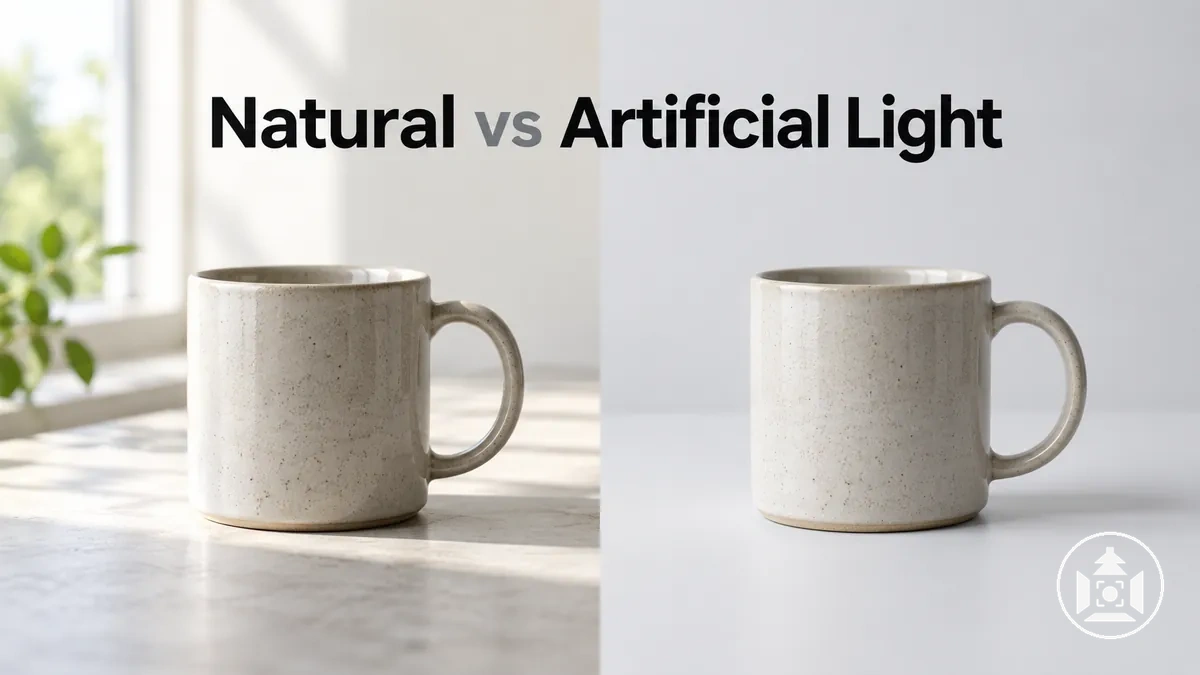
Which light source fits this product shoot?
Choose by the production constraint that matters most. The source label does not decide image quality by itself; control, repeatability, daylight availability, setup demands, and the required light character determine the practical fit.
Natural light tends to fit when
- usable daylight already reaches the shooting area;
- daytime scheduling is workable;
- lower dedicated-lighting equipment needs are valuable;
- strict cross-session repeatability is not the dominant constraint.
Artificial light tends to fit when
- catalogue batches or reshoots need a reproducible lighting state;
- the shoot must continue beyond suitable daylight;
- source position and output need deliberate adjustment;
- the added equipment, power, space, and setup can be accommodated.
Do not decide by source label alone
- softness and hardness depend on apparent source size and diffusion;
- shadow and highlight placement depend on source angle and position;
- colour consistency depends on maintaining a stable lighting mix and white-balance workflow;
- either source can work when its conditions match the production requirement.
Decision rule: use artificial light when repeatability, scheduling independence, or deliberate control is the limiting factor; use natural light when suitable daylight already meets the required look, control, and schedule with less dedicated lighting equipment.
Table of Contents
How Natural and Artificial Light Differ for Product Photography
Natural light and artificial light can both support product photography, but they differ in controllability, environmental dependence, repeatability, and setup requirements.
Natural light is tied more closely to daylight conditions, while artificial light allows the photographer to set and reproduce lighting conditions with less dependence on weather or time of day.
The comparison below applies the same criteria to both sources so their production implications remain directly comparable.
It focuses on how each source affects a product shoot rather than on detailed lighting techniques.
| Comparison criterion | Natural light | Artificial light |
|---|---|---|
| Controllability | Direction and intensity are constrained by the available daylight and can be modified within the setup. | Light output and positioning can be deliberately adjusted within the capabilities of the lighting setup. |
| Environmental dependence | Availability and intensity are affected by time of day, weather, season, and the shooting environment. | Operation is less dependent on daylight, weather, and time of day when suitable equipment and power are available. |
| Repeatability | Reproducing the same lighting state can become harder when daylight conditions change between shots or sessions. | A recorded setup and repeated light settings can make comparable lighting conditions easier to reproduce across repeated shoots. |
| Colour consistency | Daylight colour can shift with time of day, weather, reflected surroundings, and mixed light, so a consistent white-balance workflow is important across repeated images. | A fixed artificial source can provide more stable colour characteristics when the same light and settings are reproduced; actual colour rendering still depends on the source and any mixed ambient light. |
| Setup requirements | A suitable daylight source such as window light is required, with modifiers added when the available light needs shaping. | Dedicated light sources are required, with stands, modifiers, power, or other positioning equipment added according to the setup. |
| Scheduling | The production window is more closely tied to usable daylight and changing environmental conditions. | Shooting can be scheduled with less reliance on daylight availability, subject to the equipment and shooting environment. |
The largest practical difference is that natural light places more of the product shoot under environmental constraints, whereas artificial light shifts more control toward the lighting setup and its repeatability.
A visual of the shooting environment can clarify where that control originates without repeating the comparison criteria.
Detailed positioning, shaping, and modification of either source belong to product photography lighting techniques.

Control Over Light Direction, Intensity and Shadows
Artificial light generally allows more deliberate adjustment of source position and light output during a product shoot, so light direction and intensity can be changed within the capabilities of the setup.
With natural light, control depends more on the available daylight, its direction and intensity, and how effectively that light can be modified.
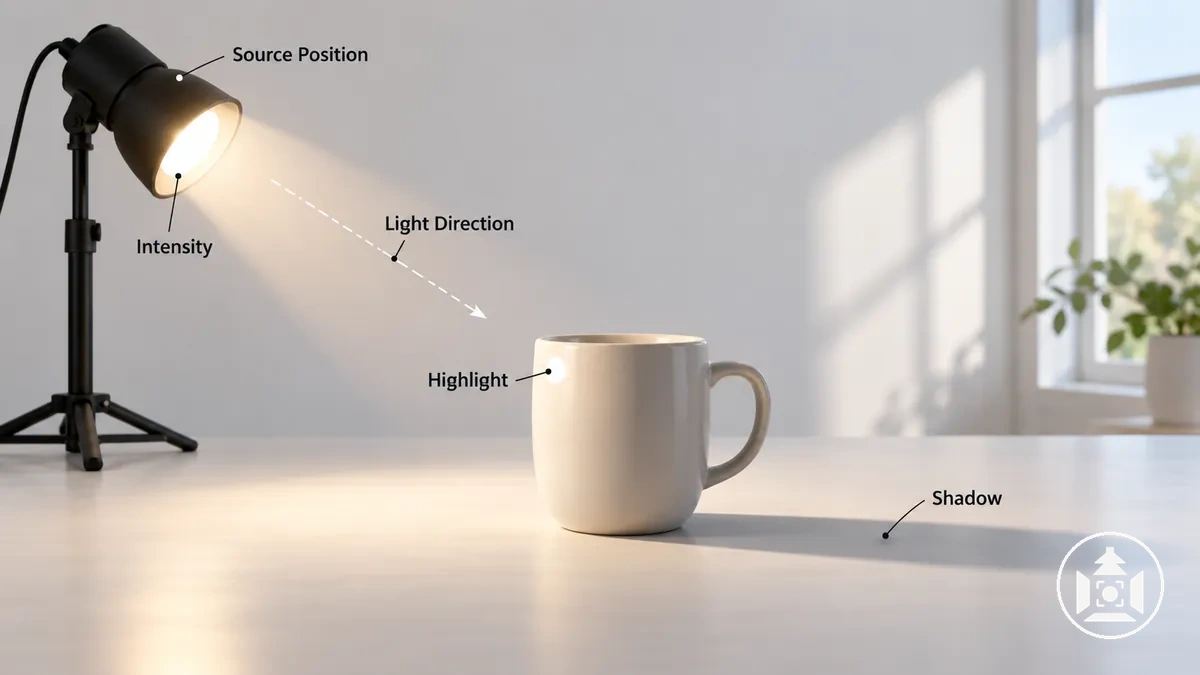
Source position affects light direction and therefore where shadows and highlights appear on the product surface.
With natural light, changes in sun position or daylight conditions can alter intensity, contrast, and shadow placement during a shoot; with artificial light, changing source position or light output allows those variables to be adjusted more deliberately.
The resulting contrast and shadows still depend on the complete lighting setup and surrounding conditions.
Natural light is not completely fixed, and artificial light is not completely controllable; both remain subject to the physical conditions of the actual setup.
The image below isolates the visible control relationship by showing how source position changes light direction and shadow placement around the same product.
Consistency Across Repeated Product Shoots
Lighting consistency across repeated product shoots means reproducing a comparable lighting state across multiple products, frames, or shooting sessions.
Repeatability is easier when the conditions that affect the light can be held stable or recorded and reproduced, but neither natural light nor artificial light guarantees matching results by itself.
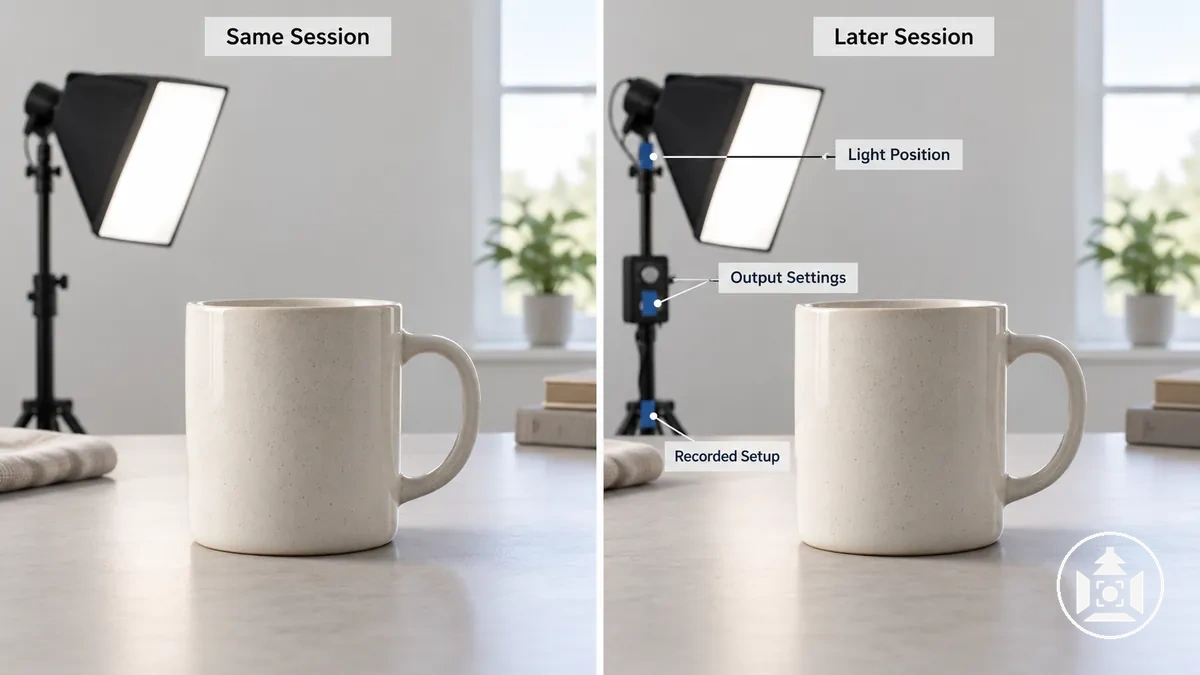
With natural light, time of day, cloud cover, window orientation, and changing intensity can alter the lighting state between frames or sessions.
With artificial light, repeatability depends on reproducing variables such as light position and output settings from a recorded setup.
Colour consistency is also part of repeatability: keep the lighting mix and white-balance method consistent across a batch. Daylight colour can change with conditions, while an artificial source is only repeatable when the same source and relevant settings are reproduced.
These variables affect whether batch production, catalogue uniformity, and later reshoots can maintain comparable lighting conditions.
The main repeatability criteria are the conditions that can change between products or sessions and the production consequence of those changes:
- Time of day: a change in daylight timing can change the available light state, making repeated natural-light images harder to match across separate sessions.
- Cloud cover: changing cloud conditions can alter daylight intensity and character during a shoot, increasing the risk of visible variation within a batch.
- Window orientation: the fixed orientation of a window determines how daylight reaches the shooting area, while changes in the sun's position can alter the resulting lighting state over time.
- Light position: reproducing the recorded position of an artificial light helps maintain comparable illumination and shadow relationships across repeated shoots.
- Output settings: recording and repeating artificial-light output settings can improve cross-session repeatability when the rest of the setup is also reproduced.
- Recorded setup: documenting relevant lighting conditions makes reshoots and batch production easier to match because the previous setup can be used as a reproducible reference.
For example, natural light may remain sufficiently stable for a group of products photographed during the same controlled session, while a reshoot on another day can encounter different time-of-day or cloud conditions.
Artificial light can make cross-session consistency easier when light position, output settings, and other setup conditions are recorded and reproduced, but the result still depends on execution.
The comparison here is limited to lighting repeatability across sessions; the broader workflow for maintaining consistent lighting covers how consistency is managed throughout production.
Light Quality and Visual Character
Light quality in product photography is not inherently soft or hard because the source is labelled natural light or artificial light.
Softness, hardness, directionality, contrast, and shadow character depend on the physical lighting conditions, including source size, diffusion, angle, distance, and the surrounding environment.
The image below illustrates how these physical attributes shape the visible character of light rather than assigning one character to either source category.
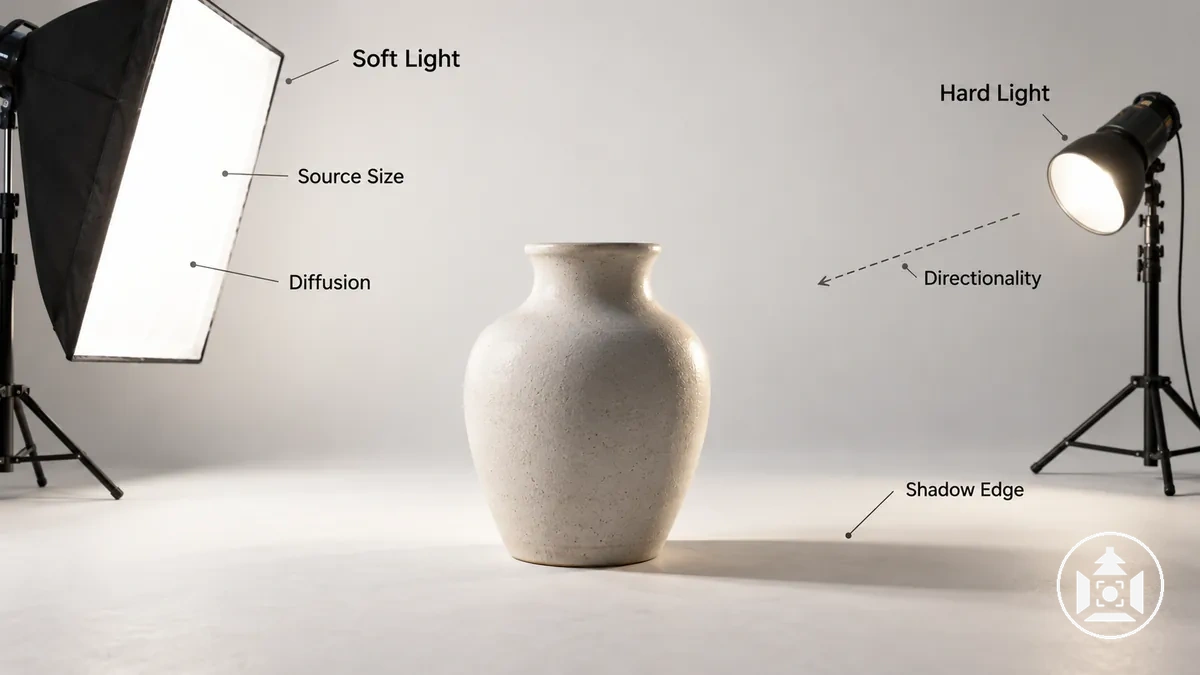
A larger apparent source relative to the product tends to produce greater softness and broader shadow transitions, while a smaller apparent source produces harder light with more defined shadow edges.
Diffusion can increase the apparent size and spread of a source, reducing contrast and softening shadow character; angle changes directionality and where highlights and shadows appear on the product surface.
Distance also changes the apparent size of the source relative to the subject, while nearby surfaces and surrounding conditions can reflect or block light and alter the resulting contrast.
Direct sunlight can produce hard light with defined shadows, while diffuse window light or overcast light can produce a softer visual character.
Artificial light can likewise be shaped toward hard light or soft light through its source size, diffusion, angle, distance, and surrounding conditions, so the resulting visual character follows those physical attributes rather than the source label alone.
Equipment and Setup Requirements
Natural light can reduce dedicated lighting equipment when suitable daylight access and usable window light are available, while artificial light usually requires a lighting unit plus supporting equipment and power.
The practical difference is therefore the type of resources the setup depends on rather than an inherent difference in image quality.
The image below illustrates the contrast in space and equipment requirements between a simple window-light arrangement and a basic artificial-light arrangement.
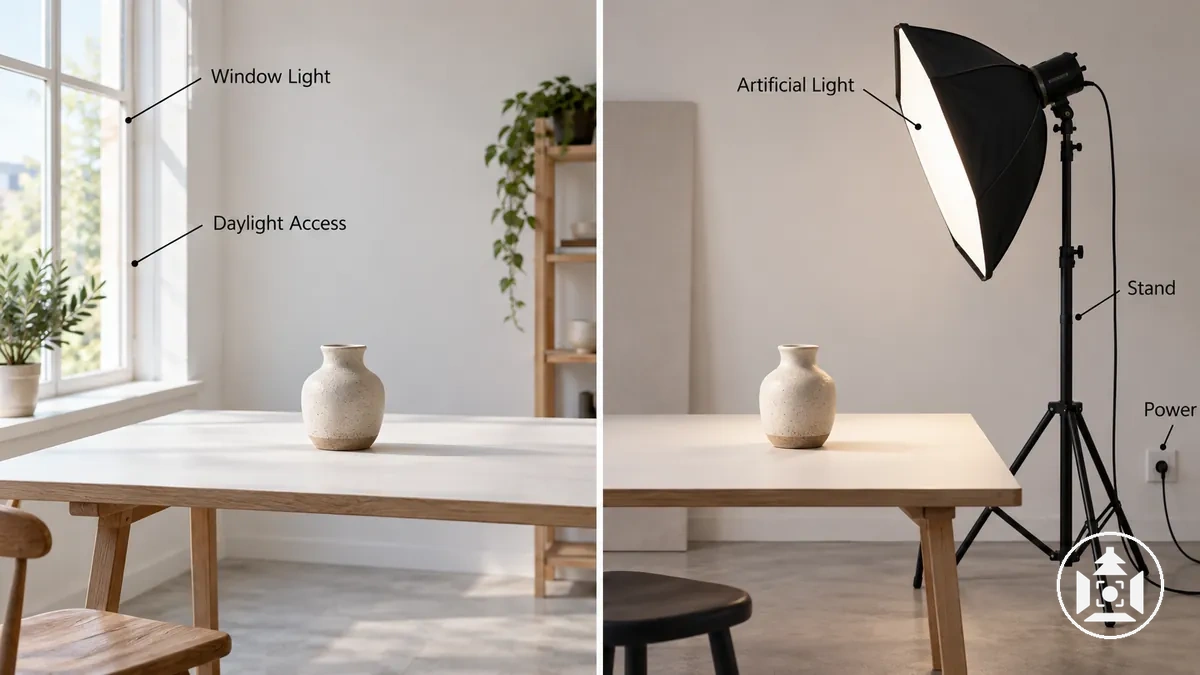
Available space affects both approaches: natural light requires a workable position relative to the daylight source, while artificial light needs space for the product, lighting equipment, and safe positioning of stands or modifiers.
Natural-light setup time depends partly on having suitable daylight available when the shoot is scheduled, whereas an artificial-light setup adds time for positioning and adjusting introduced lighting equipment.
Artificial light also depends on an appropriate power source unless the particular lighting unit has another supported power arrangement.
The main resource requirements can therefore be assessed from the working environment outward to the equipment itself:
- Daylight access: natural light depends on usable daylight reaching the working area; suitable window light can provide a minimum viable setup without a dedicated lighting unit, while reflectors or diffusion can be optional refinements when the available light needs shaping.
- Space: a natural-light arrangement needs enough working space to position the product and camera relative to the daylight source, while an artificial-light arrangement also needs appropriate space for the introduced light and its support hardware.
- Power: window light does not require electrical power for the light source itself, while powered artificial light requires access to its applicable power arrangement during the shoot.
- Lighting equipment: usable window light can serve as the primary source without dedicated lighting equipment, whereas artificial light requires at least an introduced lighting unit as the source.
- Stands and modifiers: artificial-light setups commonly add a stand or other support for positioning the source, with modifiers used when the required light character calls for them; natural-light setups may also use modifiers, but they are refinements rather than a requirement in every usable daylight situation.
- Setup time: a simple daylight arrangement can involve fewer lighting components to position when suitable conditions already exist, while an artificial-light arrangement adds setup burden through placement, support, power, and adjustment of the introduced source.
Minimum viable requirements are condition-specific: natural light requires suitable daylight access and a workable shooting position, while artificial light requires an introduced light source and whatever support and power that configuration needs.
Additional stands, modifiers, reflectors, or other refinements become relevant only when the intended setup requires greater shaping or positioning of the light.
Time, Weather and Shooting Flexibility
Natural light is more dependent on time of day, weather, season, and daylight availability, so these conditions can limit or shift the usable production window for a product shoot.
Artificial light can reduce that dependence by providing an introduced light source when daylight conditions are unsuitable, giving the shooting schedule greater flexibility.
Room orientation affects when and how usable daylight reaches the shooting area, while weather, season, and time of day can change daylight availability and therefore the timing available for natural-light work.
These changes can affect operational planning when a production window is limited or reshoots must be completed under suitable lighting conditions.
Artificial light can make an evening shoot or a rescheduled production window less dependent on available daylight, provided the required power, setup conditions, and controlled environment are available.
It therefore improves scheduling flexibility but does not eliminate every environmental or setup constraint.
Trade-Offs of Natural and Artificial Light
The trade-off between natural light and artificial light is not a choice between benefits and drawbacks in isolation; each practical advantage is paired with a constraint that matters under particular shooting conditions.
Natural light can offer convenience when suitable light is available, while artificial light can offer greater control and predictability at the cost of added setup burden.
Convenience can favour natural light when its availability already matches the product shoot, but that same dependence on available light can reduce predictability when conditions change.
Artificial light shifts the relationship toward control and predictability because the light is introduced and managed within the setup, while the equipment and preparation required add setup burden.
That burden can support greater scheduling independence when the shoot must proceed without relying on suitable daylight.
The practical advantage therefore changes with the constraint: easy availability can reduce preparation in one situation yet restrict timing in another, while a more involved setup can require preparation yet make the shooting window less dependent on daylight.
The suitability of either source depends on which trade-off carries the greatest operational significance under the actual shooting conditions.
A product shoot that can use suitable available light may value convenience differently from one that places greater priority on predictable lighting availability and scheduling independence.
Natural Light: Advantages and Limitations
Natural light can reduce equipment dependence and provide accessible soft directional light for product photography when suitable daylight or window light is available.
Its availability, intensity, and character can change with shooting conditions, so these advantages remain condition-dependent rather than inherent to natural light.
The practical value of natural light is clearest when each benefit is considered with the condition that enables it or the constraint that can counter it.
The following points translate those paired effects into product-shoot implications without assuming that daylight is sufficient for every product or situation.
- Accessibility and equipment dependence: Natural light can reduce dependence on dedicated lighting equipment when usable daylight already reaches the shooting area, but that accessibility becomes a constraint when suitable daylight is not available where or when the product shoot must occur.
- Soft directional light: Natural light from a suitably diffused window can provide soft directional light with gradual shadow transitions, while direct or less-diffused daylight can produce a harder shadow character instead.
- Variability: Natural light can support a simple product shoot while daylight remains sufficiently stable, but changing weather or time of day can alter its intensity and character during the working period.
- Time dependence: Natural light is available according to daylight conditions, which can suit a shoot scheduled within a usable daylight window but limit flexibility when the required production time falls outside those conditions.
- Positional control: Natural light can provide useful illumination when the available source direction suits the product, but its fixed environmental source position can offer less positional control than an introduced light that can be deliberately repositioned.
Artificial Light: Advantages and Limitations
Artificial light generally improves deliberate control, repeatability, and scheduling independence in product photography when the setup is managed consistently.
Controlled lighting allows light output and source position to be set for the production need, while the equipment, space, and setup complexity required to create that control add practical demands.
The net value of artificial light comes from balancing those production advantages against the conditions required to maintain them.
The following points pair each advantage with its operational requirement or limitation rather than treating equipment or controlled lighting as a benefit by itself.
- Control: Artificial light allows deliberate adjustment of light output and source position, but useful control depends on correctly positioning and setting the introduced light for the product shoot.
- Repeatability: Artificial light can improve repeatability when source positions, settings, and other relevant setup conditions are recorded and reproduced, but equipment alone does not create consistency between shoots.
- Scheduling independence: Artificial light can reduce dependence on daylight availability and support production outside a usable daylight window, but the shoot still requires suitable equipment, power, space, and setup conditions.
- Equipment and space: Artificial light provides an introduced, controllable source, but stands, modifiers, power arrangements, and their positioning can increase the space and equipment burden of the setup.
- Setup complexity: Artificial light can provide a stable basis for controlled lighting once the setup is established, but achieving the intended result requires learning how positioning, settings, and execution affect the product image; equipment ownership alone does not produce consistent or professional results.
Choosing the Right Light for the Shooting Situation
Lighting-source suitability should follow the dominant shooting constraint rather than a universal preference.
Natural light may be more suitable when usable daylight and its visual character fit the shoot, while artificial light may be more suitable when repeatability needs, scheduling flexibility, or deliberate light control carry greater weight.
The decision flow below organizes repeatability needs, shooting schedule, daylight availability, equipment access, available space, visual character, production volume, and the required degree of light control.
Each condition points toward a suitable lighting direction without treating that direction as mandatory when both sources can meet the production requirements.
- If repeatability needs or production volume are high: artificial light may be more suitable when catalogue work, repeated batches, or reshoots require a lighting state that can be deliberately recorded and reproduced; natural light can still fit when daylight conditions can be managed with sufficient stability.
- If the shooting schedule extends beyond suitable daylight availability: artificial light may fit better because controlled lighting reduces dependence on time of day and weather, provided the required equipment, power, and working conditions are available.
- If usable daylight is available but equipment access or space is limited: natural light may be more suitable when the product can be positioned effectively within the available daylight and the resulting light control meets the shoot requirements.
- If precise light control is the dominant requirement: artificial light may be more suitable when deliberate adjustment of source position and light output is needed, provided the setup can be managed consistently within the available space.
- If a particular visual character is the main requirement: either natural light or artificial light can work when source size, diffusion, direction, distance, and surrounding conditions can produce the intended result; the source category alone does not determine softness or hardness.
- If the constraints are compatible with both sources: either source may be suitable, so the decision can follow which option meets the required repeatability, schedule, daylight, equipment, space, and control conditions with fewer operational conflicts.
Either source can fit the same product shoot when its conditions are managed well, and the preferred option can change when one constraint changes.
For example, usable daylight may suit a shoot with a flexible schedule, but artificial light may become more suitable if the same work must later be completed during an evening shoot or repeated under a controlled lighting state.
Likewise, access to artificial lighting does not make it preferable when available daylight already provides the required visual character and sufficient control.
Suitability remains tied to the actual production conditions rather than to the source label alone.
When Natural Light Is More Suitable
Natural light is more suitable when usable daylight is available, the shooting window supports daytime scheduling, and strict cross-session consistency requirements are not the dominant constraint.
Its suitability becomes weaker when changing daylight conditions or repeatability needs make the required result difficult to reproduce across the planned production.
The practical fit depends on whether the environment and production requirements support the available daylight.
The following situations pair each favourable condition with the factor that could reverse the choice:
- Usable window light: Natural light can fit when window light provides a suitable direction and character for the product, but becomes less suitable when changing daylight prevents the required lighting state from being maintained.
- Open shade: Natural light can fit when open shade provides sufficiently soft directional light for the intended visual character, but changing weather or daylight conditions can reduce that suitability.
- Daytime scheduling: Natural light can fit when the shooting window aligns with usable daylight, but becomes less suitable when production must continue outside that window or the schedule cannot accommodate changing conditions.
- Simple setup and moderate production volume: Natural light can support a simple setup with limited dedicated lighting equipment when suitable daylight is already available, but higher repeatability needs, reshoots, or production volume can favour a more controllable source.
- Soft directional visual character: Natural light can fit when available window light or open shade produces the intended visual character, but the decision can reverse when greater light control or stricter cross-session consistency is required.
For example, a home setup can suit natural light when usable window light and daytime scheduling match the product shoot, but the location alone is not a reason to choose it if changing conditions conflict with the required consistency.
Broader methods for photographing products without a studio belong outside this lighting-source suitability decision.
When Artificial Light Is More Suitable
Artificial light is more suitable when repeatability, scheduling independence, or deliberate light control outweigh the added setup demands.
It can improve repeatability when the lighting setup is recorded and reproduced, while its scheduling flexibility reduces dependence on usable daylight.
The practical fit depends on which operational requirement limits the product shoot.
The following situations connect that requirement to artificial-light suitability without assuming that controlled lighting guarantees the result:
- Repeated catalogue work: Artificial light may fit when catalogue work or repeat production has higher consistency requirements because a recorded setup can support repeatability across products or reshoots; it becomes less decisive when stable natural light can meet the same requirements.
- Evening or window-limited shooting: Artificial light supports scheduling independence when an evening shoot or window-limited shooting makes daylight availability incompatible with the production window, provided the added lighting setup can be accommodated.
- Precise highlights and shadows: Artificial light is more suitable when the product image requires deliberate source positioning to control where highlights and shadows appear, while natural light can still work when its available direction can be modified sufficiently for the intended result.
- Higher consistency requirements: Artificial light can improve repeatability when light position, output, and other relevant setup conditions are reproduced consistently, but changing the setup or execution can still change the resulting lighting state.
- Control-sensitive product surfaces: Artificial light may fit when reflections, contrast, highlights, or shadows require tighter light control around the product surface, but its suitability depends on how effectively the lighting is positioned and managed rather than on the source category alone.
Control-sensitive surfaces can require specialized techniques beyond this source-selection decision, particularly when reflections must be managed around the product.
Those methods belong to lighting reflective products.